
Direct answer
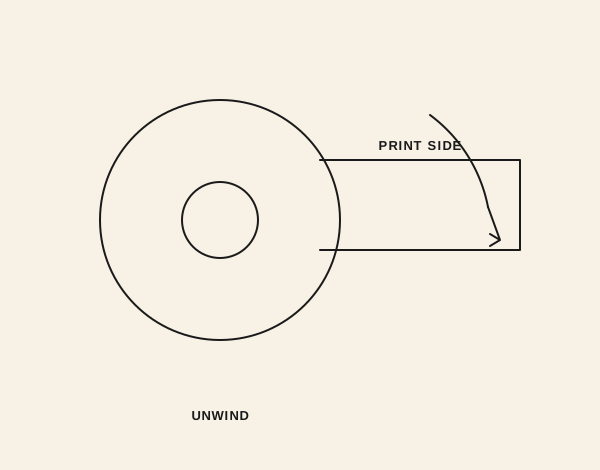
This is a converting spec
A finished pouch spec and a roll spec are not interchangeable. On roll stock, your machine forms the package. The supplier has to wind a web your unwind, your former, and your seal jaws can use. Missing one roll field is how a correct-looking print fails on the line.
Read the definition if you are still deciding what roll stock is. Use the commercial printed roll stock page if you are ready to order film for a form-fill-seal line. Use the dimension explainer if you need to measure width, repeat, and unwind. Stay here to fill in the sheet.
Geometry: width, roll diameter, core, and weight
Web width is the film from edge to edge, not the finished package width. Roll outside diameter and roll weight have to fit the unwind. Core inside diameter has to fit the shaft. There is no single core that fits every machine. Copy the core from the machine or the current roll label.
Send the largest roll the machine will accept, in diameter or weight, whichever limit you hit first. A film that is right in every other way still will not run if the roll does not fit.
Unwind direction and print orientation
Unwind is which way the print faces as the film leaves the roll, and which edge leads. It is the mistake that wastes a whole roll: the print can be correct and still present backward or inside out to the former.
Do not write copy up or logo first and stop there. Copy the unwind from the current roll label or from a diagram the machine owner recognizes. A photo of both ends of the roll, the label, and the unwind as it mounts is the practical version of that diagram.
Repeat length and the seal cycle
Print repeat is the distance along the web from one image to the next. Cutoff is the length at which the machine separates packages. They have to agree with the seal cycle. Mixing them up builds the art to the wrong length.
If several packages sit across the web, say how many lanes, and whether the repeat you are sending is one package or one full repeat of the layout. The impression calculator turns repeat and length into a count when those inputs are known.
Registration and print placement
Registration is how colors line up with each other and with the cut, the eye mark, and the seals. Small type, a barcode, and an eye mark need a tolerance, not a hope. Say where the eye mark sits, its size, its color, and the clear space around it.
Keep print out of seal areas unless that construction is approved. Send the dieline with the art so the repeat, the seals, and the eye mark are one drawing.
Cores, plugs, and handling
Ask how the roll is protected: core plugs, wrap, and how the roll may be stacked or stood. A crushed core or a telescoped roll is a line stop even when the print is right. Say whether splices are allowed and how they must be marked.
If your receiving dock has a weight or diameter limit that is tighter than the machine, send the dock limit too. The roll has to arrive as well as run.
What to confirm with the operator first
The person who runs the machine knows the fields a spreadsheet misses. Confirm width, repeat, unwind, core, maximum roll, eye mark, and splice rules with them before you send the request. A buyer and an operator who disagree should resolve it before the supplier guesses.
- Machine make and model
- Web width the machine is set to pull
- Repeat or cutoff the seals use
- Unwind, from the label or the manual
- Core inside diameter and the largest roll
- Eye mark and splice rules
Copy-paste roll stock spec
Paste this into the quote request. Add the product, the structure or a sample, the artwork or a color count, the order quantity, annual usage, and the ship-to location. PCI's standard lead time is 3 to 4 weeks after artwork approval.
Request a quote with the roll spec
Send the sheet, or send the machine details and fill the sheet with Matt. A roll label photo is enough to start when the written spec is incomplete.
| Field | What to write | Where it comes from |
|---|---|---|
| Web width | Edge to edge, with the unit | Machine setup or current roll |
| Repeat | One print length along the web | Art, dieline, or cutoff |
| Unwind | Direction and print side | Roll label or unwind diagram |
| Core | Inside diameter | Shaft or current core |
| Roll limit | Maximum diameter or weight | Unwind and the dock |
| Eye mark | Size, color, position, clear space | Sensor and current art |
| Splices | Allowed or not, and how marked | Operator and quality spec |
| Structure | Layers, or unknown plus a sample | Current spec, not a guess |
Questions buyers ask
What information do I need to order printed roll stock?
Product, machine make and model, web width, repeat, unwind, core, maximum roll, eye mark, structure or a sample, artwork or a color count, quantity, and ship-to location.
Why does unwind direction matter?
The print has to face the right way as the film leaves the roll. A roll wound the wrong way will not present the art to the former, even when the design itself is correct.
What is print repeat length?
The distance along the web from one printed image to the next. It has to match the machine's cutoff and seal cycle. It is not the same number as web width.
How is roll stock quoted differently from finished pouches?
Roll stock is quoted from the web: width, repeat, unwind, core, and roll limits. A pouch is quoted from the finished bag size and features. Send the format you actually buy. The comparison is on the pouch versus roll stock page.
What roll diameter should I order?
The largest roll your unwind and your dock will accept, unless a smaller roll is a handling rule you already run. There is no universal diameter.
See something that needs correcting? Tell Matt.