Direct answer
Step 1. Say what you pack and why you are asking
Name the product, its form (powder, liquid, solid, frozen, fresh), and the fill weight or count. Then say why you need the quote: a new launch, a cost comparison, a second source, a performance problem, or a machine change. Each reason leads the supplier to different questions, so stating it saves a round of emails. A frozen product is a different job from a shelf-stable one; the frozen food notes keep the cold chain and the filling line in the same conversation.
- Product and fill weight or count
- Storage and distribution conditions, such as frozen, refrigerated, or shelf stable
- Reason for the quote
Step 2. Name the format
Say whether you buy rollstock, premade pouches, or bags, and which style. If you are not sure which format fits, say how the product will be filled and the supplier can help you decide.
- Rollstock, stand up pouch, flat pouch, side gusset bag, wicket bag, or other
- Current format if this is an existing item
Step 3. Give dimensions the way the supplier needs them
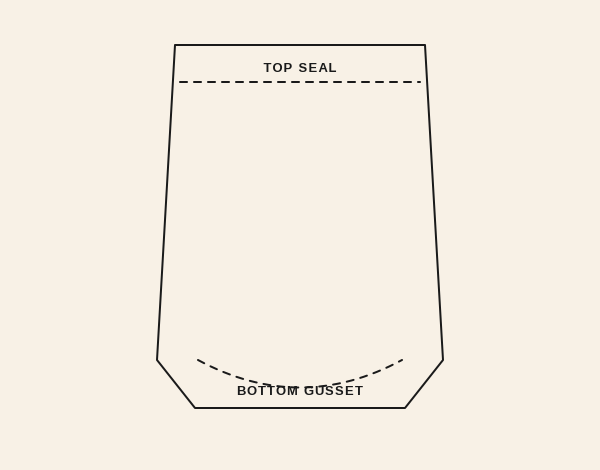
For pouches and bags, give finished outside dimensions and the gusset. For rollstock, give web width and repeat or cutoff. Make sure the artwork file, the specification, and your email all show the same size, because a mismatch is one of the most common reasons a quote changes later.
- Pouches and bags: width, length, gusset, lip, seal widths
- Rollstock: web width, repeat or cutoff
Step 4. Share the structure, or say you do not know it
If you have an approved specification, send it. If not, send an unused package or a photo of the roll label. If the structure is unknown, write unknown and describe what the package must do, such as keep out oxygen or moisture, survive freezing, or show the product through a window.
Step 5. Describe print and artwork
Send the artwork and dieline if you have them. If not, give the number of colors, how much of the surface is printed, whether the print is on the surface or buried between layers, and how many artwork versions share the same size and structure.
- Artwork file and dieline, or estimated colors and coverage
- Number of SKUs or versions
- Any color standards you need matched
Step 6. Separate annual usage from order quantity
Annual usage tells the supplier how big the program is. Order quantity tells them how much you will buy at one time. Both matter, and they answer different questions. If you do not know annual usage, give recent order sizes and how often you reorder, and label it as an estimate. Annual usage is also what turns a per-unit difference into annualized savings.
Step 7. Describe the filling equipment or method
For rollstock, give the machine make and model, unwind direction, core size, maximum roll diameter or weight, and any eye mark or splice rules. For pouches, say whether they are filled by hand, on a semi automatic filler, or on an automatic pouch line, and how the top is sealed. If a co packer fills the product, ask them for this information and send it with the RFQ.
- Machine make and model
- Unwind direction, core size, roll limits (rollstock)
- Fill and seal method (pouches)
Step 8. List the features
List every feature the package needs, such as a zipper, spout, degassing valve, tear notch, hang hole, window, rounded corners, or easy open seal. Features change converting steps and can change lead time.
Step 9. State performance and documentation needs
State barrier requirements with units and test conditions where you have them, target shelf life, freezer or hot fill exposure, puncture or drop requirements, and which food contact or compliance documents you need. If you have approved quality tolerances, include them.
Step 10. Give the ship to location and timing
Give the ship to city and ZIP, the delivery basis you want quoted, and the date you need product on the dock. Say which approvals are still open, such as artwork, structure, or a line trial, so the supplier can plan a realistic schedule. A plant in New Jersey, Connecticut, Pennsylvania, or elsewhere in the Northeast still needs that same ship-to and RFQ. The regional page does not replace it.
Do not invent missing data
If the structure is unknown, say so. If the quantity is an estimate, label it. If the launch date is a target, explain what approvals remain. Accurate uncertainty is more useful than false precision, and it keeps the comparison between suppliers fair.
| Have this? | Send it | It may reveal |
|---|---|---|
| Approved specification | PDF or original document | Structure, gauge, dimensions, tolerances |
| Artwork | Artwork file and dieline | Repeat, colors, eye mark, print layout |
| Roll label | Clear photo | Width, length or weight, item code, lot |
| Package sample | Unused, and filled if possible | Format, features, handling |
| Purchase history | Order quantities and frequency | Volume pattern |
Questions buyers ask
Can I get a quote without artwork?
Often a preliminary quote can start without final artwork if dimensions, estimated colors, print coverage, quantities, and format are known. Final pricing and production still need approved artwork.
What if I do not know annual usage?
Share recent order quantities and how often you reorder, or give a reasonable range. Label it as an estimate.
Do I need to know my film structure to get a quote?
No. Send an unused package, a roll label photo, or the old specification, and describe what the package must protect against. Mark the structure as unknown rather than guessing.
Why do suppliers ask for the filling machine?
Rollstock has to run on a specific machine, so web width, repeat, unwind, core, and sealant all depend on it. For pouches, the filling and sealing method affects dimensions, seal design, and features.
How can I make quotes from different suppliers comparable?
Send every supplier the same information, mark the same fields as unknown, and ask each to state its assumptions. Then compare quotes on the same structure, quantity, features, and delivery basis.
See something that needs correcting? Tell Matt.