
Direct answer
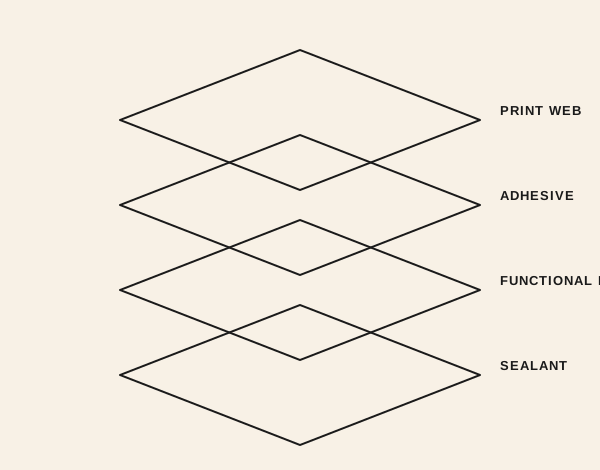
PET is not one film
Packaging buyers often use PET to mean a polyester print web, but grades and treatments vary. PET may be selected for clarity, stiffness, printability, heat response, or dimensional control. It may be coated or metallized. The abbreviation does not define thickness or sealant behavior.
Polypropylene includes different forms
BOPP is biaxially oriented polypropylene. CPP is cast polypropylene. Orientation changes stiffness, tensile behavior, shrink response, and other properties. A BOPP print web and a CPP sealant web should not be treated as interchangeable because both contain polypropylene.
Compare the job, not the abbreviations
Ask what role the film serves: outside print web, barrier carrier, sealant, stiffness layer, or single-web bag. Then define temperature, moisture, oxygen, seal, friction, appearance, toughness, and converting requirements.
| Property/topic | PET | Polypropylene |
|---|---|---|
| Family | Polyester | Polyolefin |
| Common oriented term | BOPET/PET | BOPP |
| General feel | Often stiffer | Varies; BOPP can be crisp |
| Moisture response | Application dependent | Often valued for moisture resistance |
| Heat/seal role | Grade and structure dependent | CPP and sealable OPP variants may serve seal roles |
Questions buyers ask
Is BOPP the same as polypropylene?
BOPP is polypropylene that has been oriented in both machine and transverse directions. It is one polypropylene film type, not the entire category.
Which film is more recyclable?
A resin name alone does not establish package recyclability. The total structure, adhesives, coatings, inks, labels, local collection, and program rules matter.
See something that needs correcting? Tell Matt.