
Direct answer
EVOH and humidity
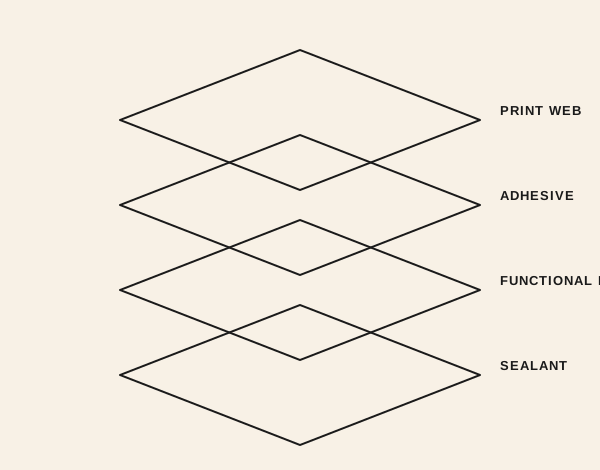
EVOH’s oxygen barrier can change as humidity increases. That is why it is commonly protected by other layers in a multilayer structure. Tie layers, adjacent polymers, layer thickness, and processing belong in the design. “Contains EVOH” does not equal a fixed oxygen-transmission rate.
PVDC as film or coating
PVDC may be used as a film component or coating where oxygen, moisture, aroma, or grease barrier is needed. Construction, coating continuity, flexing, sealing, converting, regulatory status, and waste-stream requirements can influence the decision.
Barrier numbers need test conditions
OTR and MVTR values are meaningless without units, temperature, relative humidity, test method, sample thickness, and whether the data describes a raw film or finished laminate. Ask for the conditions before comparing decimals.
Product validation still wins
A barrier model can narrow options. It cannot replace shelf-life work with the actual product, process, seal, headspace, package geometry, and distribution conditions.
| Question | EVOH | PVDC |
|---|---|---|
| Primary discussion | Strong oxygen barrier | Oxygen + moisture barrier possibilities |
| Moisture sensitivity | Barrier changes with humidity | Grade/construction dependent |
| Typical form | Layer in coextrusion/laminate | Film or coating |
| Selection input | Humidity + full layer design | Performance + process + end-of-life constraints |
Questions buyers ask
Is EVOH a film by itself?
In packaging it is commonly used as a thin functional layer within a multilayer structure because other layers can protect it and provide sealing or mechanical properties.
Which has better oxygen barrier?
That cannot be answered responsibly without grade, thickness, humidity, temperature, structure, and test conditions.
See something that needs correcting? Tell Matt.