
Direct answer
What it does
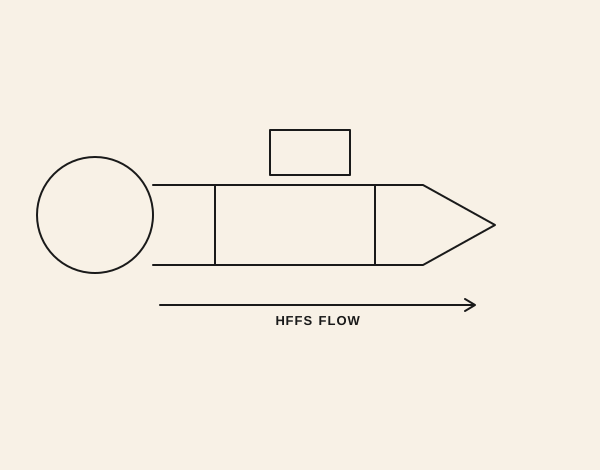
A horizontal form-fill-seal (HFFS) machine, also called a flow wrapper, wraps discrete solid items horizontally as they travel on a conveyor, forming a longitudinal seal plus two end seals. It is favored for uniformly shaped solids such as bars, cookies and bundled products and generally runs faster than a VFFS line.
- Horizontal flow wrap is terminology a buyer may see in a specification, report, or machine discussion.
- conveyor infeed is terminology a buyer may see in a specification, report, or machine discussion.
- longitudinal + end seals is terminology a buyer may see in a specification, report, or machine discussion.
Why a buyer might care
Solid, uniform items run best on flow wrappers; picking the wrong machine limits speed.
The useful part is knowing which question this concept can help answer before comparing documents, requesting data, or planning a trial.
What it does not automatically tell you
This general explanation does not establish compatibility with a specific machine, product, film construction, line speed, or operating condition.
Boundary: This page organizes buyer and project information. It does not approve a film structure, gauge, barrier target, seal condition, food-contact position, shelf life, recyclability claim, machine setting, or supplier for a specific application.
Questions to ask
- Which method, material, orientation, and conditions does this information apply to?
- Is the value a typical result, a controlled specification, or an application requirement?
- Who owns approval when the package, machine, product, or process changes?
- What sample, report, specification, or machine record should stay with the decision?
Source and next reference
The source lineage for this page is preserved below. Use it to identify the relevant standard, OEM explanation, or trade reference; obtain the current full standard or controlled supplier document when the decision depends on it.
Related work
See something that needs correcting? Tell Matt.